
“Sacred Words in Secular Court: Aga Khan’s Historic Lawsuit Against His Own Followers”

For the first time in Ismāʿīlī history, the Aga Khan bypassed his community’s internal arbitration boards (These boards were designed to keep conflicts within the community, avoiding secular courts) and turned to Canadian civil courts, suing two followers over the unauthorized publication of his Farmans and Talikas. The case shocked the faithful, raised unprecedented questions about religious authority and copyright, and drew international media attention.
- The lawsuit: Aga Khan IV (the spiritual leader of the Nizari Ismāʿīlīs) filed a lawsuit in Canadian courts against Alnaz Jiwa and Nagib Tajdin, both members of the Canadian Ismāʿīlī community.
- The claim: The Aga Khan alleged that Jiwa and Tajdin infringed his copyright and moral rights by compiling and distributing a book containing his speeches and writings.
- The book included 589 Farmans (oral addresses given by the Aga Khan to his followers) and 77 Talikas (written religious messages).
- The Aga Khan asserted he was the sole author of these materials.
Unprecedented move: Instead of using the Ismaili International Conciliation and Arbitration Board (ICAB) or National Conciliation and Arbitration Board (NCAB)—institutions he himself established for internal dispute resolution—he turned to secular Canadian courts. This was seen as a break from tradition.
- Community reaction: Many Ismāʿīlīs were “deeply concerned” because this set a precedent: followers could now be taken to secular courts if they disobeyed the Imam.
- Legal uniqueness: Colleen Spring Zimmerman, a Toronto lawyer, noted that she had never seen a case in which a religious leader sued his own followers. She highlighted the unusual focus on moral rights—whether the Aga Khan could prevent the reproduction of his words solely on that basis.
- In contrast to broader Islam, the page emphasizes that in mainstream Islam, religious texts such as Hadith collections (Sahih Bukhari, Sahih Muslim, etc.) are widely available and openly shared. By contrast, Ismāʿīlī literature (Farmans, rituals) is tightly controlled and often kept secret, with restrictions even on recording inside worship halls.
- Hadith precedent: The Prophet Muhammad initially forbade writing down hadiths during the Qur’ān’s revelation to preserve clarity. Later, after the conquest of Makkah, he allowed recording, leading to the canonical collections Muslims use today.
- Ismāʿīlī secrecy: Unlike mainstream Islam’s openness, Ismāʿīlīs restrict access to their religious texts. The internet has exposed some of these materials, but the community still enforces strict rules against recording or sharing them.
The case was widely reported in Canadian media:
Additionally, Aga Khan’s team set up a website, lawsuit2010.com, which publicly criticized Jiwa and Tajdin.
This was historic because:
- It broke with the Ismāʿīlī tradition of internal arbitration.
- It raised questions about the balance between religious authority and secular law.
- It highlighted the tension between secrecy in Ismāʿīlī practice and the openness of mainstream Islamic traditions.
It wasn’t just a copyright case—it symbolized a deeper struggle over authority, transparency, and the control of religious knowledge.
The news article can be found in newspapers as follows:
http://www.lawtimesnews.com/20100419753/headline-news/lawyer-sued-by-aga-khan-keeping-the-faithFollowing the backlash, the news articles were later taken down from the website. A screenshot and a PDF print of the original article are provided here for reference
source: Lawyer sued by Aga Khan keeping the faith
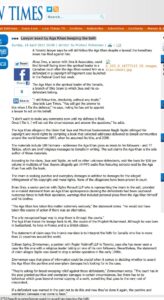
http://www.thestar.com/news/gta/2010/04/12/aga_khan_files_lawsuit_against_toronto_lawyer.html
http://www.torontosun.com/news/torontoandgta/2011/01/10/16832076.html
. The news articles were later taken down from the website. A screenshot and a PDF print of the original article are provided here for reference
source: Two Canadians ordered to stop selling Aga Khan’s speeches | Toronto & GTA | News | Toronto Sun
Following the backlash, the news articles were later taken down from the website. A screenshot and a PDF print of the original article are provided here for reference
: Aga Khan Lawsuit Home
– July 1, 2010
sources: Aga Khan Lawsuit Lawsuit
If you like our work, do support us by clicking on the Support Us button
Support Us
Elaina Ali Twitter